
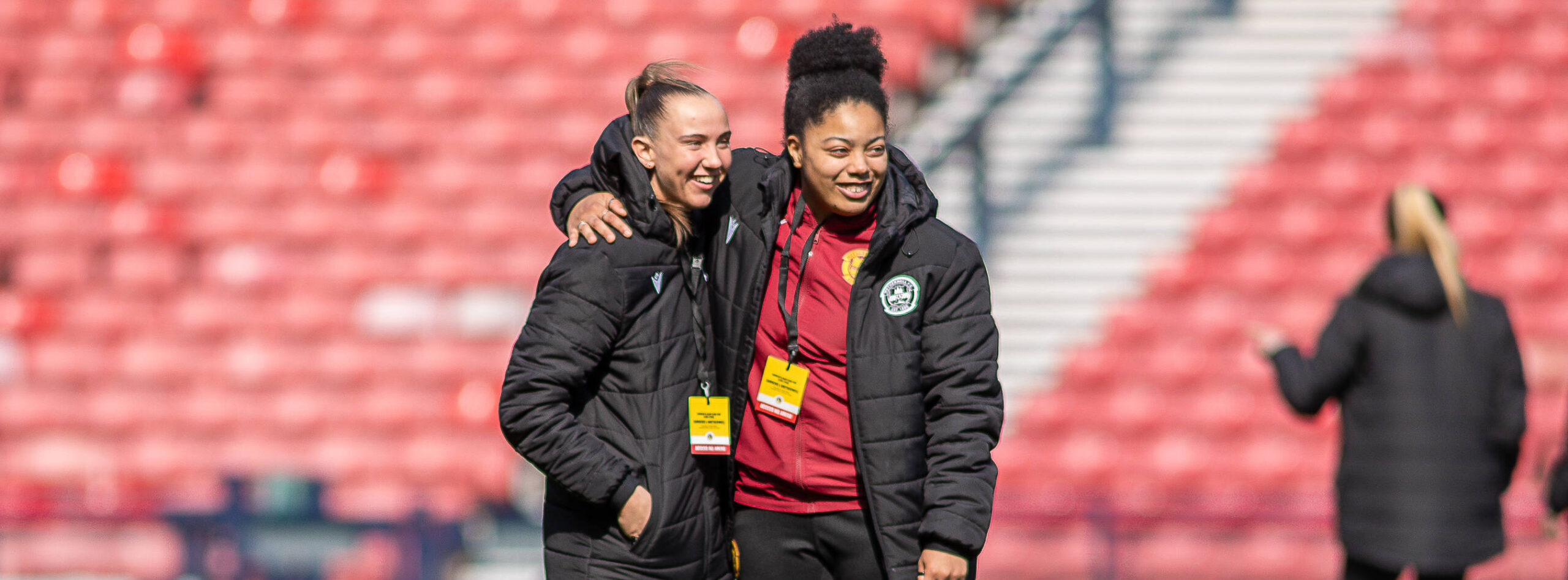
Kaela McDonald-Nguah has been playing football since she was four, starting in boys’ teams before joining Celtic Women’s Academy. She worked her way up through the ranks, gaining experience at Spartans Women, Motherwell, Gartcairn, Dundee United and most recently Montrose. Football has always been a constant in Kaela’s life, shaping her career and providing strength during her most challenging times.
“I have suffered with low moods and depression since I was diagnosed around 13 or 14. For a long time I never found anything that helped,” Kaela explains. She reflects on how her mental health struggles affected school, football and everyday life. “At the end of last year, it got to a point where I felt there was no way out, and I just wanted a break from the intrusive thoughts I was having. Unfortunately, I attempted suicide.”
Support became a lifeline. “The biggest thing that helped me was being open and transparent with coaches, my teammates and staff, including the chaplain. They made me feel normal and supported. Going back to football was the best thing for me.” Access to a psychologist during her time at Dundee United proved transformative. “Without that interaction I probably would not be playing football as it stands. The support from the club and the psychologist was life changing.”
“Which, looking back, obviously something that I majorly regret, but I think on the back of that, the positives that have come from it have been unbelievable and kind of shaped how I’m feeling and how I have a more positive outlook on life now.”
Football itself provided structure, purpose and focus, with Kaela emphasising the power that football has had on her life. “I used football as an escape. It was the one thing I could have control of. The discipline and teamwork on the pitch mirrored what I needed in my life off it.” Through training, matches and the camaraderie of her teammates she rebuilt her confidence and began to regain hope.

Credit: Richard Wiseman / Dundee United FC.
Her experiences have also changed how she approaches mental health and World Suicide Prevention Day; she wants to raise more awareness. “We need to start treating mental health the same way we treat physical injuries. Speaking to someone can open doors. You are not a burden. I am still searching for answers, but I am the closest I have ever been, and that is because I have been open and transparent about it.”
Kaela highlights the importance of community within football. “If everyone is feeling down, even small gestures like a teammate asking ‘are you alright’ at training can go a long way. Football has taught me to look after myself but also to support other players.”
“I think the biggest thing is knowing that speaking to someone is not as scary as you think. I think the best advice I’ve had was from the chaplain. She put it very bluntly, she said ‘I would much rather you called me at any time of the hour to ask for help than getting a call any time of the hour to see that something’s happened to you.’ So I think the biggest thing is knowing that people do care. Even if everyone’s got their own problems and own issues, if someone came knocking on my door I would want to go and help. So, it’s about recognising that that’s the same for people around.”
Today, Kaela continues to play the game she loves with a renewed outlook on life. Her story is a testament to the strength found in speaking out. She is keen to put more emphasis on the resources that are available to players – resources that will hopefully become more developed and sought out.
“I think there needs to be greater awareness of mental health and suicide, and a better understanding of how even small actions can help someone get through each day. Player welfare and wellbeing should be treated as a real priority, not just discussed in passing.”
“I was extremely fortunate at Dundee United to have access to a psychologist and other support, but that shouldn’t be about luck – every player should have the opportunity to speak to someone and receive meaningful, ongoing support both on and off the pitch. Resources from PFA Scotland, as well as support available through chaplains and clubs, are invaluable and should be more widely promoted. With the right guidance and tools, players can feel supported, cared for, and better able to manage the pressures of football while looking after their mental health.”
If you are affected by any of the issues in this story, please reach out to Sporting Chance, our dedicated mental health partner.
Their direct line is available for members to use 24/7 at 07780008877 with more information available online.